Showing posts with label culture. Show all posts

Friday, January 1, 2016

sunrises and fukubukuro

A few year's back, I wrote about some of the Christmas customs in Japan. This year, I thought I'd touch on some of the many traditions surrounding the coming of the new year, also known as Shogatsu!

Before the New Year

While most of the celebrations and traditions take place on New Year's Eve and New Year's Day, some of them begin much earlier and continue well into the new year. For example, it's customary to decorate a few days before the new year begins using kadomatsu (ornamental decorations to place outside the home or business) and shimekazari (wreaths that are hung above door posts) made of pine, rice straw, and/or bamboo. These also typically contain items that are considered to be auspicious, such as oranges (to symbolize multiple generations and a long family line), or plum blossoms (symbolic of the spring to come and new life).

                       Shimekazari hanging near a doorway                                           Kadomatsu outside a home

Another tradition that begins a bit before the actual new year is known as o-souji, which literally means "big cleaning." Similar to the American "spring cleaning," this is a time to purify one's house and/or workspace to make them ready and fresh for the new year.

Before the new year arrives, it's customary to send out nengajyo, or New Year's cards. The post offices are often very busy during this time of year because of this, though apps and e-cards to make your own nengajyo are becoming more and more popular. The cards often have the zodiac animal for the new year in addition to wishes for prosperity and health. This is a wonderful way to let friends and family know that you're thinking of them as the new year arrives, just as westerners often do during the Christmas/holiday season.

New Year's card for 2016, the year of the monkey 

New Year's Eve

New Year's Eve is a time for family and friends! Many travel to their hometowns to be with family during this time, and others host parties and celebrations with food and games. There are a few popular television programs that air annually on New Year's Eve as well! Some of these include Kohaku (a New Year's Eve music show that divides popular musical artists into competing teams) and Gaki no Tsukai  (a variety and comedy show that includes a segment where the participants are put into silly situations and must try not to laugh - if they laugh, they are hit on the behind with a bat, which often makes the rest of the participants laugh).

At midnight, it's customary to visit a local shrine or temple to literally ring in the new year, in addition to giving thanks for the protection of the previous year and to pray for a prosperous year to come. The Buddhist temples ring the bells 108 times at the stroke of midnight to welcome the new year.

Small Shinto shrine near our house at midnight on New Year's Eve

New Year's Day 

Hatsuhinode is the first sunrise of the year, and it's customary to wake up early in order to watch the sun come up for the first time in the new year. Often, mountaintops and beaches are packed with people, as these locations offer beautiful views of the sunrise. We are lucky to live where we do right now, because a beautiful view of the sun rising over the water is just feet away!

Hatsuhinode view from our balcony - Jan. 1, 2016

It's a good thing there are several Starbucks shops nearby for an early morning energy boost, because New Year's Day is a huge day for shopping! Likened to Black Friday, January 1 is a good day to find deals at your favorite shops. While many shops offer store-wide discounts from January 1-5, one of the main draws during this time is known as fukubukuro. Fukubukuro are known as lucky bags - they are basically surprise bags with goods inside. Usually the bags are sealed to keep the contents a secret, though basic descriptions are provided so you at least know the general type of product you're purchasing. Sometimes, sample bags are even displayed so the purchaser has an idea of what to expect!

We've seen fukubukuro at grocery stores, bakeries, mall shops, and even designer suit stores! The bags range in price, depending on the shop and the contents. The price is set for each type of bag, but you won't know what exactly you purchased until you unpack the contents after returning home. Typically, the bags have multiple items inside and the price you pay is a fraction of what you would have paid for the items separately.
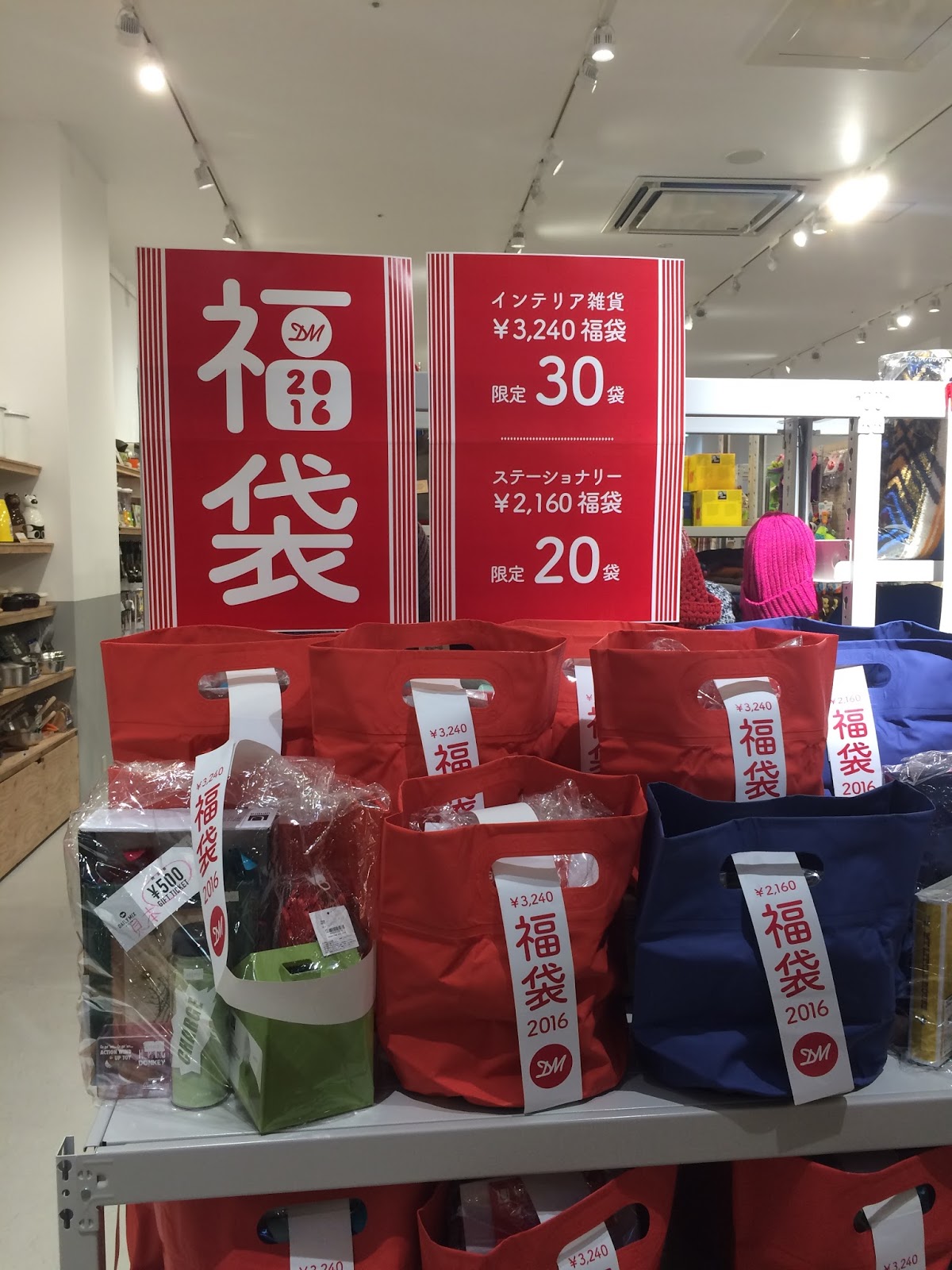

Some of the fukubukuro we saw at the mall today

We really lucked out this year with what we bought! It's exciting to have a mall nearby, and we found fukubukuro at many of our favorite shops. After purchasing a few lucky bags, we returned home to unwrap our surprises. We tallied up the total cost of what we spent versus the total worth of the items, and found that we only spent about 1/3 of the total worth! What a deal!

 
Fukubukuro goodies: great deals on some things we've been wanting for a while!

These are just a few of the many New Year's traditions we've encountered so far in Japan, though I know there are several others! We wish you a happy new year, regardless of where you are, and hope that you enjoy your annual customs and traditions!


Saturday, November 22, 2014

cultural exchange

Every year, our class gets the wonderful opportunity to visit a local Japanese elementary school. Cultural exchanges like this are just one of the bonuses of living on an overseas base, and the students (both American and Japanese) look forward to them! The focus of our visits usually centers around the process of planting, harvesting, and cooking rice so that students are able to see the entire process.

Our partner school has a wonderful relationship with local farmers and other adults in the community who volunteer their time (and rice) for this opportunity.

In October, we visited the school to learn how to thresh rice after it's been harvested from a nearby field. The students who attend our partner school actually took part in the planting of this rice earlier in the year. Our hosts talked about and showed us a variety of different tools used throughout history for threshing, and then gave us an opportunity to try it ourselves. The kids, both Japanese and American, had a great time using the machinery and separating the grains from the plants.


In November, we visited again. This time, our focus was on cooking the rice we had previously threshed. We learned how to cook the rice and then pound it, roll it out, and slice it to make mochi. The students were then able to eat the mochi in a broth-based soup and as a sweet dish with red bean paste.


While there, we were also taught how to make spinners (tops) out of cardboard cartons as well as samurai hats from newspaper. Even with the language barrier, our students were able to communicate and play with their new Japanese friends. They taught each other their favorite games and variations on games they all played (like Rock-Paper-Scissors/Janken).


We look forward to inviting our partner students to our school later in the school year to reciprocate their kindness and to share a bit of our culture with them!

Wednesday, June 19, 2013

sleepless in seattle

We've arrived! I know this blog post has the cliche Seattle title, but jet lag makes your brain fuzzy and I haven't slept much over the last few days!

Our trip to Seattle, overall, was great compared to our travel to Japan two years ago!

We decided that it would be easier to take the Patriot (military flight) directly from our base to Seattle rather than flying commercially, which would mean a flight to Tokyo, a change in airports, and then a 14 hour flight to the states. This way, we only had a 10 hour flight, plus 4 hours in the muggy (non-air-conditioned) flight terminal. Way better than 28 hours non-stop, like last time!

The plane ride only moderately comfortable, but better than was expected. We entertained ourselves with iPad games and the in-flight movies (which consisted of The Matrix and National Lampoon's  Vacation...random much?)

Landing in Seattle was more arduous than expected, though. We didn't feel much of the expected culture shock when we arrived in Japan, but we definitely felt it coming back.

The chaos and disorganization going through customs were overwhelming. After grabbing our luggage from 4 different carousels, we made it down to the rental car terminal and made our way to the nearest grocery store with a Starbucks to use wi-fi.

Driving on the right side again (and actually having traffic lanes to drive through) was crazy! And then we arrived. Just a random Safeway, but we both stopped for a full thirty seconds in the entrance. Bombarded with a florist, banking services, a Starbucks kiosk, a movie store, and a bakery before even entering the grocery section reminded us we were not in Kansas Japan any longer! No more small markets for us! The Wal Mart was even crazier. It's amazing how two years can change your perspective so much, with things any American completely takes for granted. I can only imagine how it must feel for a foreigner to come to America for the first time.

We got ourselves set up with a T-Mobile hotspot so we could use our Japanese phones, and headed back to the airport. We had found out a week earlier that my bestie, May, was flying back from South Africa only hours after we arrived! It was a loud and celebratory reunion and it was great to know we were both back on American soil together.

We then headed to a 100% gluten free bakery I had researched (Haley's Corner Bakery - see the review here if you're interested!) and had our first American meal: deep dish pizza. It was delicious! We then made our way up to Everett to find Bethel's house.

Long day, but we're so excited to be here in Seattle!