Showing posts with label japan. Show all posts

Saturday, September 10, 2016

navigating Okinawa's gluten free options

Moving to a new country can be daunting for even the most adventurous of spirits, but when you have food allergies or sensitivities, it can cause the feeling of excitement to turn to dread. While celiac disease and gluten sensitivity are more related to auto-immune disorders than to true food allergies, the strict avoidance of allergens is the only way to stay healthy! I'll admit that when we found out we were moving to Okinawa, I had no idea what to expect as far as handling my food allergy issues. I am sensitive enough that I even react to most of the "gluten free" items sold at the base commissaries and other grocery stores. I've been pleasantly surprised, though, by the number of farmers markets and fresh-produce restaurants around the island!

If you or someone you know has celiac disease or gluten intolerance, here are a few shops and restaurants that have been friendly and accommodating when it comes to these "food allergy" issues!

But first, a few notes:

**Please keep in mind that gluten and the sensitivity to it are virtually unknown throughout most of Asia, and that most restaurant employees will not know which items do or don't have gluten in them. In fact, the word "gluten" does not exist in the Japanese language. You and you alone will need to be the judge of whether a food product is safe for your consumption.

**There are a few restaurants (and packaged products) that will call themselves "gluten free," but since the handling of gluten is so unknown here, many of these proprietors do not understand the concept of cross contamination! Please use this solely as a guide to start your own research into places that may be safe for you!

**Also, remember that Okinawans tend to be very patient and gracious with us as we try to navigate our way through finding safe foods. Extra smiles and "thank you's" will go a long way in helping restaurant employees to want to continue helping us along the way!


Re:FOOD

This market opened recently in Araha, and it's full of celiac safe goodies! The shop sells gluten free items from the United States as well as from various parts of Europe and even Australia! They also have shop-made ice creams, juices, and other locally made fresh options.

While the items here will be a bit more pricey than shopping from Vitacost, there's something almost magical about being able to drive to a store to pick up an item you need instead of having to wait two weeks for your groceries to arrive.


Green Leaf

Not too far from Re:FOOD is Green Leaf, a small shop boasting a large array of organic food options. While not every item will be safe for someone with celiac, they do carry several difficult-to-find gluten free items! Green Leaf also has a small cafe, where you can get a delicious smoothie or coffee beverage.

If you find you want to shop there frequently, make sure you pick up a point card. The more purchases you make, the closer you will be to earning a "percent off" reward.


Yakiniku King

I've written about Yakiniku King before, and we've never been disappointed in our visits there! If you're new to Japanese cuisine, yakiniku is translated as "grilled meat" and refers to a broad variety of bite-sized meats cooked on a grill.

Yakiniku King can be great for those with specific food allergies, because they have an expansive kitchen with different areas for different types of food. While you will do the most of your ordering using the tablet at your table, it's best to talk with the server ahead of time to let them know about your allergies. I keep a translation on my phone at all times so that I can easily hand it to the server who comes by the table to ask which set you prefer. Some of them are more well-informed than others, but the servers who don't understand will typically go get a manager. Usually, that manager will bring an allergy card to let you know which items have which common allergens.

When you go, it's best to stick to plain meats and vegetables. Ask for your food to come "shiodake" (salt only), as most of the sauces will not be safe. Even the butters can have added "aminos" that contain gluten in some form, so plan to bring your own soy sauce if you want to dip! The tablet ordering system will often ask if you want sauce or salt only, but it's best to speak with the server ahead of time as well.

When cooking, remember that you are sharing a grill with the people at your table. If you are very sensitive, you may want to consider cooking all of your food first, and then letting the others at your table have free reign of the grill. If you aren't as sensitive, it may be okay for you to have one section of the grill to yourself, as long as you ensure nothing with sauce touches your designated area!

*Note: There are some occasions where something with sauce has made its way to our table, so do make sure that you double-check the meats that come your way. If this occurs, the servers have always been gracious and have swapped it out with a salt-only item. I am extremely sensitive to cross contamination, and I have never been contaminated here!


Kasthamandap - Nepal Spice Kitchen

Spice Kitchen is a great choice if you like curry, because they have a separate little area for making the naan! There are several curries you can safely order on the menu, and if you let the server know you have an allergy to wheat (they do not know what gluten is, but they know what wheat flour is), they will let you know which items to avoid. All the curries have an option to come with plain rice, so you'll have something on your plate to soak in that delicious, spiced goodness!

*The person making the naan does not touch the curry and does not serve customers. I always ask for our server to wash his/her hands though, just in case. They've never questioned me about this, and I've never gotten sick here!


Ajitoya

I've saved my favorite for last, because anyone who knows me knows that I'm obsessed with this restaurant. The reggae music and Araha waterfront view (especially at sunset) make for a fun and relaxing ambiance. The food, though, is truly delightful! The soup curry is loaded with healthy vegetables and a warm broth that reminds me of Grandma's home-cooked soup.

Ajitoya has two different sections on their menu. One is soup curry and one is keema. The keema curry has soy sauce and other gluten-containing ingredients, so you'll want to stay on the "soup curry" side of the menu. I've tried almost every item on the soup curry menu, and I've never had a reaction. Even the sausage, which can often contain gluteny fillers, caused no noticeable reaction!

Ordering here is easy, and I never even need to mention my gluten-related issues in order to get a safe meal. All you need to do is choose your soup curry, add your spice level, and voila!

There are three locations on the island, all of them as delicious and warm and friendly as the next.


I hope that this article will help you to find some new ways to explore the wonderful food options that Okinawa has to share, while also keeping you safe and healthy! If you have experienced some great gluten-free meals on the island, feel free to let me know in the comments!

navigating Okinawa's gluten free options

Moving to a new country can be daunting for even the most adventurous of spirits, but when you have food allergies or sensitivities, it can cause the feeling of excitement to turn to dread. While celiac disease and gluten sensitivity are more related to auto-immune disorders than to true food allergies, the strict avoidance of allergens is the only way to stay healthy! I'll admit that when we found out we were moving to Okinawa, I had no idea what to expect as far as handling my food allergy issues. I am sensitive enough that I even react to most of the "gluten free" items sold at the base commissaries and other grocery stores. I've been pleasantly surprised, though, by the number of farmers markets and fresh-produce restaurants around the island!

If you or someone you know has celiac disease or gluten intolerance, here are a few shops and restaurants that have been friendly and accommodating when it comes to these "food allergy" issues!

But first, a few notes:

**Please keep in mind that gluten and the sensitivity to it are virtually unknown throughout most of Asia, and that most restaurant employees will not know which items do or don't have gluten in them. In fact, the word "gluten" does not exist in the Japanese language. You and you alone will need to be the judge of whether a food product is safe for your consumption.

**There are a few restaurants (and packaged products) that will call themselves "gluten free," but since the handling of gluten is so unknown here, many of these proprietors do not understand the concept of cross contamination! Please use this solely as a guide to start your own research into places that may be safe for you!

**Also, remember that Okinawans tend to be very patient and gracious with us as we try to navigate our way through finding safe foods. Extra smiles and "thank you's" will go a long way in helping restaurant employees to want to continue helping us along the way!


Re:FOOD

This market opened recently in Araha, and it's full of celiac safe goodies! The shop sells gluten free items from the United States as well as from various parts of Europe and even Australia! They also have shop-made ice creams, juices, and other locally made fresh options.

While the items here will be a bit more pricey than shopping from Vitacost, there's something almost magical about being able to drive to a store to pick up an item you need instead of having to wait two weeks for your groceries to arrive.


Green Leaf

Not too far from Re:FOOD is Green Leaf, a small shop boasting a large array of organic food options. While not every item will be safe for someone with celiac, they do carry several difficult-to-find gluten free items! Green Leaf also has a small cafe, where you can get a delicious smoothie or coffee beverage.

If you find you want to shop there frequently, make sure you pick up a point card. The more purchases you make, the closer you will be to earning a "percent off" reward.


Yakiniku King

I've written about Yakiniku King before, and we've never been disappointed in our visits there! If you're new to Japanese cuisine, yakiniku is translated as "grilled meat" and refers to a broad variety of bite-sized meats cooked on a grill.

Yakiniku King can be great for those with specific food allergies, because they have an expansive kitchen with different areas for different types of food. While you will do the most of your ordering using the tablet at your table, it's best to talk with the server ahead of time to let them know about your allergies. I keep a translation on my phone at all times so that I can easily hand it to the server who comes by the table to ask which set you prefer. Some of them are more well-informed than others, but the servers who don't understand will typically go get a manager. Usually, that manager will bring an allergy card to let you know which items have which common allergens.

When you go, it's best to stick to plain meats and vegetables. Ask for your food to come "shiodake" (salt only), as most of the sauces will not be safe. Even the butters can have added "aminos" that contain gluten in some form, so plan to bring your own soy sauce if you want to dip! The tablet ordering system will often ask if you want sauce or salt only, but it's best to speak with the server ahead of time as well.

When cooking, remember that you are sharing a grill with the people at your table. If you are very sensitive, you may want to consider cooking all of your food first, and then letting the others at your table have free reign of the grill. If you aren't as sensitive, it may be okay for you to have one section of the grill to yourself, as long as you ensure nothing with sauce touches your designated area!

*Note: There are some occasions where something with sauce has made its way to our table, so do make sure that you double-check the meats that come your way. If this occurs, the servers have always been gracious and have swapped it out with a salt-only item. I am extremely sensitive to cross contamination, and I have never been contaminated here!


Kasthamandap - Nepal Spice Kitchen

Spice Kitchen is a great choice if you like curry, because they have a separate little area for making the naan! There are several curries you can safely order on the menu, and if you let the server know you have an allergy to wheat (they do not know what gluten is, but they know what wheat flour is), they will let you know which items to avoid. All the curries have an option to come with plain rice, so you'll have something on your plate to soak in that delicious, spiced goodness!

*The person making the naan does not touch the curry and does not serve customers. I always ask for our server to wash his/her hands though, just in case. They've never questioned me about this, and I've never gotten sick here!


Ajitoya

I've saved my favorite for last, because anyone who knows me knows that I'm obsessed with this restaurant. The reggae music and Araha waterfront view (especially at sunset) make for a fun and relaxing ambiance. The food, though, is truly delightful! The soup curry is loaded with healthy vegetables and a warm broth that reminds me of Grandma's home-cooked soup.

Ajitoya has two different sections on their menu. One is soup curry and one is keema. The keema curry has soy sauce and other gluten-containing ingredients, so you'll want to stay on the "soup curry" side of the menu. I've tried almost every item on the soup curry menu, and I've never had a reaction. Even the sausage, which can often contain gluteny fillers, caused no noticeable reaction!

Ordering here is easy, and I never even need to mention my gluten-related issues in order to get a safe meal. All you need to do is choose your soup curry, add your spice level, and voila!


I hope that this article will help you to find some new ways to explore the wonderful food options that Okinawa has to share, while also keeping you safe and healthy! If you have experienced some great gluten-free meals on the island, feel free to let me know in the comments!

Sunday, January 10, 2016

yummy yakiniku

If you've been in Japan for very long, you will probably have heard about yakiniku. If you're new to Japanese cuisine, yakiniku is translated as "grilled meat" and refers to a broad variety of bite-sized meats cooked on a grill. It's very easy to make yakiniku at home, and you'll often see locals cooking in this style with portable grills during festivals.

Yakiniku with veggies, rice, and lettuce
This style of cooking is also popular in restaurants, and as many have discovered, not all yakiniku restaurants are considered equal. Many of these establishments include all-you-can eat buffets or sets, where diners can choose their style of raw meats and veggies to cook on their own table-top grills. While it may be tempting to choose an inexpensive ¥1000, all-you-can eat yakiniku restaurant, the variety and quality of ingredients typically won't be very high. This is where Yakiniku King comes in!


Located on Highway 58 between Camp Foster and Kadena Air Base, Yakiniku King offers better quality meats, including several types of beef, chicken, pork, and seafood that are available in differently priced sets. The sets, which start at about ¥2600 per person for dinner, include a variety of different ingredients and meals to choose from. The mid-range set (referred to as the "Standard Course," which costs ¥2900) contains more than 100 different food options, to include rice and lettuce, meat and seafood, noodle dishes, Korean bibimbap, hot pots, various side dishes, and even dessert options!


Once diners have chosen their set, ordering is a breeze! All you have to do is choose the dishes you want to try, using a handy handheld digital tablet. There is even an English option for those customers who aren't able to read Japanese! Once the order is placed electronically, a server will bring your food and beverages right to the table. Orders are unlimited, as long as you place and eat them within the allotted 90 minute time frame.


While ordering on the tablet is entertaining, the real pleasure comes cooking and eating the actual meal. Once your raw food arrives, you can season and cook it to your liking with your table's built-in grill and the provided selection of sauces. Some meats come with sauce already and others come with only salt, so you can use soy, ponzu, lemon, or yakiniku sauce(s) to glaze your meat or use for dipping later on.


Customer service at Yakiniku King is wonderful! The servers can be called to refill drinks or provide a new grill net at the push of a button. The food is of nice quality and the vast variety of foods on the menu provides options for meat-lovers, for vegetarians, and for those who may have food allergies. It's no wonder this place has become one of our family's favorite places for a dinner with friends!


Friday, January 1, 2016

sunrises and fukubukuro

A few year's back, I wrote about some of the Christmas customs in Japan. This year, I thought I'd touch on some of the many traditions surrounding the coming of the new year, also known as Shogatsu!

Before the New Year

While most of the celebrations and traditions take place on New Year's Eve and New Year's Day, some of them begin much earlier and continue well into the new year. For example, it's customary to decorate a few days before the new year begins using kadomatsu (ornamental decorations to place outside the home or business) and shimekazari (wreaths that are hung above door posts) made of pine, rice straw, and/or bamboo. These also typically contain items that are considered to be auspicious, such as oranges (to symbolize multiple generations and a long family line), or plum blossoms (symbolic of the spring to come and new life).

                       Shimekazari hanging near a doorway                                           Kadomatsu outside a home

Another tradition that begins a bit before the actual new year is known as o-souji, which literally means "big cleaning." Similar to the American "spring cleaning," this is a time to purify one's house and/or workspace to make them ready and fresh for the new year.

Before the new year arrives, it's customary to send out nengajyo, or New Year's cards. The post offices are often very busy during this time of year because of this, though apps and e-cards to make your own nengajyo are becoming more and more popular. The cards often have the zodiac animal for the new year in addition to wishes for prosperity and health. This is a wonderful way to let friends and family know that you're thinking of them as the new year arrives, just as westerners often do during the Christmas/holiday season.

New Year's card for 2016, the year of the monkey 

New Year's Eve

New Year's Eve is a time for family and friends! Many travel to their hometowns to be with family during this time, and others host parties and celebrations with food and games. There are a few popular television programs that air annually on New Year's Eve as well! Some of these include Kohaku (a New Year's Eve music show that divides popular musical artists into competing teams) and Gaki no Tsukai  (a variety and comedy show that includes a segment where the participants are put into silly situations and must try not to laugh - if they laugh, they are hit on the behind with a bat, which often makes the rest of the participants laugh).

At midnight, it's customary to visit a local shrine or temple to literally ring in the new year, in addition to giving thanks for the protection of the previous year and to pray for a prosperous year to come. The Buddhist temples ring the bells 108 times at the stroke of midnight to welcome the new year.

Small Shinto shrine near our house at midnight on New Year's Eve

New Year's Day 

Hatsuhinode is the first sunrise of the year, and it's customary to wake up early in order to watch the sun come up for the first time in the new year. Often, mountaintops and beaches are packed with people, as these locations offer beautiful views of the sunrise. We are lucky to live where we do right now, because a beautiful view of the sun rising over the water is just feet away!

Hatsuhinode view from our balcony - Jan. 1, 2016

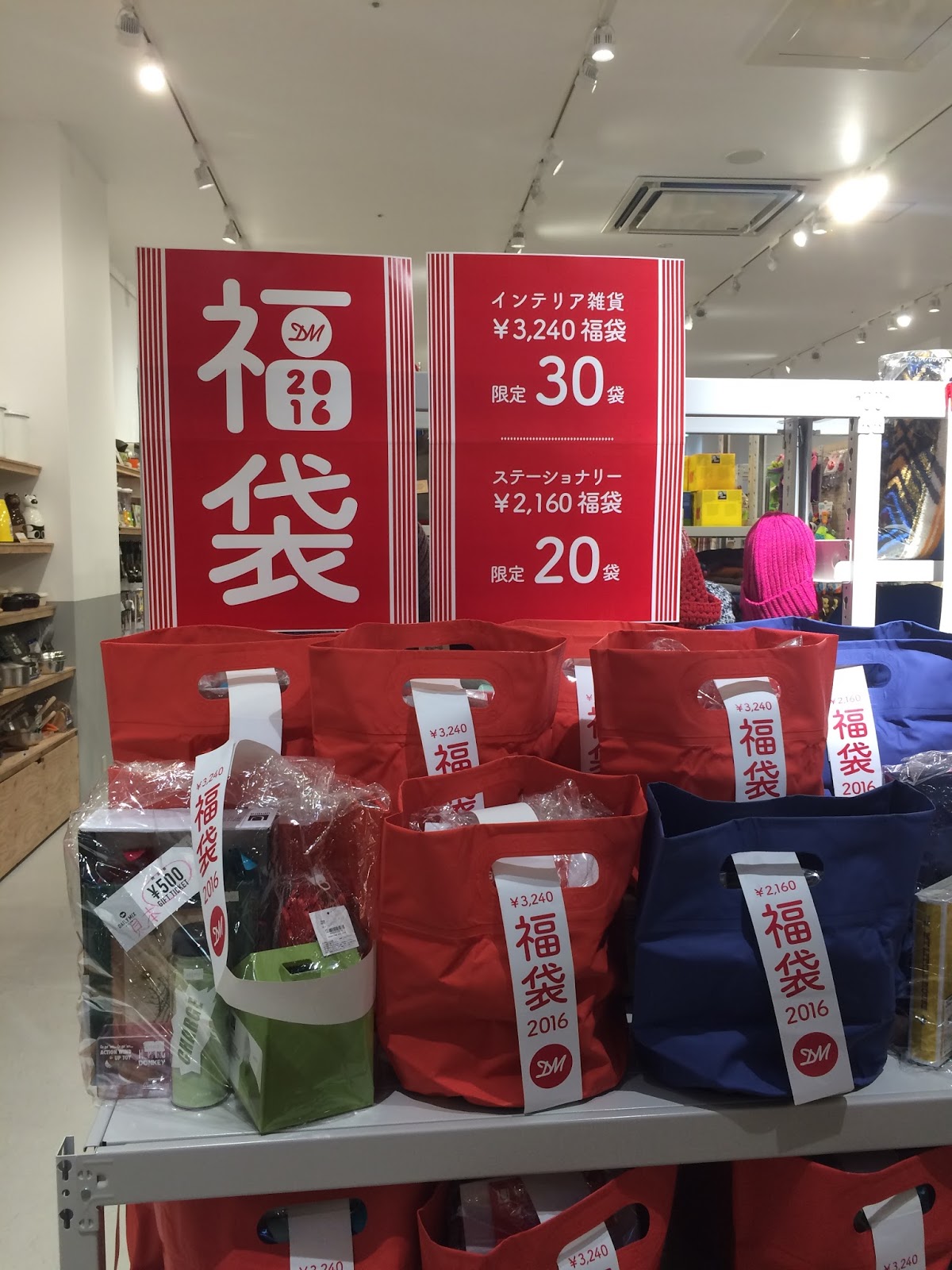
It's a good thing there are several Starbucks shops nearby for an early morning energy boost, because New Year's Day is a huge day for shopping! Likened to Black Friday, January 1 is a good day to find deals at your favorite shops. While many shops offer store-wide discounts from January 1-5, one of the main draws during this time is known as fukubukuro. Fukubukuro are known as lucky bags - they are basically surprise bags with goods inside. Usually the bags are sealed to keep the contents a secret, though basic descriptions are provided so you at least know the general type of product you're purchasing. Sometimes, sample bags are even displayed so the purchaser has an idea of what to expect!

We've seen fukubukuro at grocery stores, bakeries, mall shops, and even designer suit stores! The bags range in price, depending on the shop and the contents. The price is set for each type of bag, but you won't know what exactly you purchased until you unpack the contents after returning home. Typically, the bags have multiple items inside and the price you pay is a fraction of what you would have paid for the items separately.


Some of the fukubukuro we saw at the mall today

We really lucked out this year with what we bought! It's exciting to have a mall nearby, and we found fukubukuro at many of our favorite shops. After purchasing a few lucky bags, we returned home to unwrap our surprises. We tallied up the total cost of what we spent versus the total worth of the items, and found that we only spent about 1/3 of the total worth! What a deal!

 
Fukubukuro goodies: great deals on some things we've been wanting for a while!

These are just a few of the many New Year's traditions we've encountered so far in Japan, though I know there are several others! We wish you a happy new year, regardless of where you are, and hope that you enjoy your annual customs and traditions!


Sunday, March 29, 2015

tokyo tasting: a gluten free guide to traveling and eating out in tokyo

Having celiac is not easy, and having it in a country that does not really recognize it as an issue makes for an interesting situation. I definitely feel lucky that we figured all of this out while living in a country where the people are extremely helpful and accommodating, but it doesn't help things that most Japanese have never heard of "celiac" or "gluten" and have no idea which foods contain the ingredients I need to avoid. Explaining a "wheat allergy" is simply not enough, since there is hidden gluten in just about everything here.

It's taken a while, but we have finally figured out our "system" here at home. Traveling, though, has been a different story. We originally transferred to Japan so we would be able to travel, experience cultures, and see the world. These were easy to accomplish pre-celiac, but they have become incredibly difficult now. When we travel these days, 2/3 of our baggage contains food in case we can't find restaurants that will serve me (this has happened - while it's frustrating, I'd rather they tell me up front they can't serve me than to serve me food that will make me sick).

On our first trip to Tokyo, I really enjoyed the city but didn't plan to visit again. It was too big, and there were too many people. We added other Japanese cities to our list of places to visit, not envisioning a return to Tokyo in the near future.

Then, celiac happened.

Our first post-diagnosis visit to Tokyo was very different than our previous time. Ben's parents were coming to visit and we had plans to join them in Tokyo for a week before traveling with them back up to Aomori. This trip, I had to research EVERYTHING ahead of time. Our schedules and destinations revolved around the few "safe" restaurants I had researched. The time leading up to our departure was full of anxiety, as there were not many resources and blogs out there to help. Those that did exist gave conflicting information. (Examples include whether plain combini onigiri or senbei are always safe bets... FYI, they're not.) Looking back, though, our trip wasn't half bad! We found a few restaurants that were able to accommodate my dietary restrictions, and even one that specifically had fluent English-speakers to help in situations like mine. The city has become one of my "safe places" and we are always excited to travel there now. We have since visited Tokyo multiple times, and continue to go back to our tried-and-true favorite places.

Sadly, some of these restaurants are no longer open. A few are, though, and I wanted to make sure to write about them in case this information can help anyone traveling to Tokyo with celiac disease or gluten intolerance.  I am extremely sensitive to cross contamination, and have never gotten sick at the following restaurants.


The first restaurant I'd highly recommend is Gonpachi. I have visited several locations of this Tokyo restaurant, and haven't gotten sick at any of them, but my favorite is the one in Nishi Azabu. I have written about this place before, but didn't really go into much detail about their allergy protocols. I was a baby celiac at that point, and I've learned that I was doing so much incorrectly at that point. I have, however, been back to this restaurant several times since, and have still had wonderful experiences every time.

While Gonpachi is an izakaya style restaurant, they use very good quality meats and vegetables in their cooking. Their noodles (which aren't gluten free) are made by hand each day, and they try to source from local farms. I won't eat at most izakaya style restaurants, but this one is my exception because of these reasons. Another reason is that Gonpachi Nishi Azabu has an "allergy specialist" to help people like me figure out what they can eat safely.

At the time of the writing of this blog, Gonapchi Nishi Azabu's allergy specialist is named Teresa. She is fabulous to work with and we always check before heading to Tokyo to ensure she will be working when we visit. Teresa speaks English and is well-versed in finding foods that are safe for those with allergies. She is willing to go back and forth between the customer and the chefs to ensure that the correct ingredients and protocols are taken to keep someone from getting contaminated.


If you go, make sure you ask her to remind the cooking staff to clean the surfaces before cooking your food.

Here are a few of my favorite things off the menu:

  • Asparagus wrapped in bacon. This is quintessential izakaya food if you eat pork. So delicious!
  • Rice bowl. Gonpachi has a few rice bowls, but none of them (as they are on the menu) are safe for someone who is very sensitive. They will, however, make one for you that is, as long as you let them know exactly what you need! I get a modified "takana meshi" - without the pickled mustard leaves and with an addition of grilled chicken and fresh avocado. They bring out all the seaweed and spices separately, so I can see exactly what will go into my bowl before it's done. I mix it up and add my safe soy sauce myself, and it's delicious!
  • Gyutan. I love beef tongue when it's done right, and it's definitely done right here. I ask for the gyutan without the sesame oil, as I have not been able to confirm that it's safe. I just use my safe soy sauce for dipping instead.
  • Chicken on a skewer. I'm not sure that this one is on the menu by itself, but they've never had an issue with making it for me. I love yakitori and rarely get to order it, because it's so difficult to find restaurants with safe cooking practices in terms of cross contamination! I order it shiodake (with salt only) and then use my soy sauce.
  • Yuzu Lime Iced Tea. I look forward to coming to Gonpachi for the yuzu tea more than anything else, especially in the summer. It's so delicious! The first post-celiac time we visited Gonpachi, I was very nervous about trying this again. Even with my corn allergy on top of everything, I did not get sick at all.


All in all, Gonpachi is definitely worth a visit!

My other favorite restaurant in Tokyo is Moti. This is an Indian restaurant near Roppongi Station. The owner speaks some English and while he doesn't know much about gluten or celiac, he is very willing to go over all ingredients with you. I can't say I've branched out as far as the menu goes, because the butter chicken curry is so good that I get it every time.


We have visited every six months or so, and the owners always remember us when we walk in. Just make sure you check every ingredient and let the owners know what you're avoiding so they can check it. Also, ask for rice instead of the naan and you'll be good to go. They have offered sticky rice in the past, so you will need to make sure you opt for plain rice (the sticky rice is not safe).


I hope this is able to help you as you navigate your way through Tokyo! Let me know if you have any great gluten free experiences at either of these (or any other) restaurants in Tokyo!


Saturday, November 22, 2014

cultural exchange

Every year, our class gets the wonderful opportunity to visit a local Japanese elementary school. Cultural exchanges like this are just one of the bonuses of living on an overseas base, and the students (both American and Japanese) look forward to them! The focus of our visits usually centers around the process of planting, harvesting, and cooking rice so that students are able to see the entire process.

Our partner school has a wonderful relationship with local farmers and other adults in the community who volunteer their time (and rice) for this opportunity.

In October, we visited the school to learn how to thresh rice after it's been harvested from a nearby field. The students who attend our partner school actually took part in the planting of this rice earlier in the year. Our hosts talked about and showed us a variety of different tools used throughout history for threshing, and then gave us an opportunity to try it ourselves. The kids, both Japanese and American, had a great time using the machinery and separating the grains from the plants.


In November, we visited again. This time, our focus was on cooking the rice we had previously threshed. We learned how to cook the rice and then pound it, roll it out, and slice it to make mochi. The students were then able to eat the mochi in a broth-based soup and as a sweet dish with red bean paste.


While there, we were also taught how to make spinners (tops) out of cardboard cartons as well as samurai hats from newspaper. Even with the language barrier, our students were able to communicate and play with their new Japanese friends. They taught each other their favorite games and variations on games they all played (like Rock-Paper-Scissors/Janken).


We look forward to inviting our partner students to our school later in the school year to reciprocate their kindness and to share a bit of our culture with them!

Saturday, May 3, 2014

sakura and sunshine

This is my favorite week of the year: Golden Week. It's that time of year when Northern Japan's sleepy winter haze finally lifts and nature seems to wake up to a new season. The snow is finally gone and the delicate pink blossoms of the sakura trees start to bloom.


This week means walks in the park, bike rides, hanami (picnics under the cherry blossoms), and day trips!

We have spent more time outside in the last week than we have in the past several months!

Seamus had his first trip to the beach and we loved watching him explore and run away from the crashing waves.


Our favorite little park was something to behold in its pink splendor, and it was a joy to hear all the laughter of children as the weather finally warmed up enough to play all day outside.


Soon, the sakura will start to fill the air with blossoms as they fall, and other flowers will bloom in their place.Tulips and lupine and hydrangea will bloom as far as the eye can see, as my favorite time of year takes hold in Japan. I love spring!