Showing posts with label tradition. Show all posts

Friday, January 1, 2016

sunrises and fukubukuro

A few year's back, I wrote about some of the Christmas customs in Japan. This year, I thought I'd touch on some of the many traditions surrounding the coming of the new year, also known as Shogatsu!

Before the New Year

While most of the celebrations and traditions take place on New Year's Eve and New Year's Day, some of them begin much earlier and continue well into the new year. For example, it's customary to decorate a few days before the new year begins using kadomatsu (ornamental decorations to place outside the home or business) and shimekazari (wreaths that are hung above door posts) made of pine, rice straw, and/or bamboo. These also typically contain items that are considered to be auspicious, such as oranges (to symbolize multiple generations and a long family line), or plum blossoms (symbolic of the spring to come and new life).

                       Shimekazari hanging near a doorway                                           Kadomatsu outside a home

Another tradition that begins a bit before the actual new year is known as o-souji, which literally means "big cleaning." Similar to the American "spring cleaning," this is a time to purify one's house and/or workspace to make them ready and fresh for the new year.

Before the new year arrives, it's customary to send out nengajyo, or New Year's cards. The post offices are often very busy during this time of year because of this, though apps and e-cards to make your own nengajyo are becoming more and more popular. The cards often have the zodiac animal for the new year in addition to wishes for prosperity and health. This is a wonderful way to let friends and family know that you're thinking of them as the new year arrives, just as westerners often do during the Christmas/holiday season.

New Year's card for 2016, the year of the monkey 

New Year's Eve

New Year's Eve is a time for family and friends! Many travel to their hometowns to be with family during this time, and others host parties and celebrations with food and games. There are a few popular television programs that air annually on New Year's Eve as well! Some of these include Kohaku (a New Year's Eve music show that divides popular musical artists into competing teams) and Gaki no Tsukai  (a variety and comedy show that includes a segment where the participants are put into silly situations and must try not to laugh - if they laugh, they are hit on the behind with a bat, which often makes the rest of the participants laugh).

At midnight, it's customary to visit a local shrine or temple to literally ring in the new year, in addition to giving thanks for the protection of the previous year and to pray for a prosperous year to come. The Buddhist temples ring the bells 108 times at the stroke of midnight to welcome the new year.

Small Shinto shrine near our house at midnight on New Year's Eve

New Year's Day 

Hatsuhinode is the first sunrise of the year, and it's customary to wake up early in order to watch the sun come up for the first time in the new year. Often, mountaintops and beaches are packed with people, as these locations offer beautiful views of the sunrise. We are lucky to live where we do right now, because a beautiful view of the sun rising over the water is just feet away!

Hatsuhinode view from our balcony - Jan. 1, 2016

It's a good thing there are several Starbucks shops nearby for an early morning energy boost, because New Year's Day is a huge day for shopping! Likened to Black Friday, January 1 is a good day to find deals at your favorite shops. While many shops offer store-wide discounts from January 1-5, one of the main draws during this time is known as fukubukuro. Fukubukuro are known as lucky bags - they are basically surprise bags with goods inside. Usually the bags are sealed to keep the contents a secret, though basic descriptions are provided so you at least know the general type of product you're purchasing. Sometimes, sample bags are even displayed so the purchaser has an idea of what to expect!

We've seen fukubukuro at grocery stores, bakeries, mall shops, and even designer suit stores! The bags range in price, depending on the shop and the contents. The price is set for each type of bag, but you won't know what exactly you purchased until you unpack the contents after returning home. Typically, the bags have multiple items inside and the price you pay is a fraction of what you would have paid for the items separately.
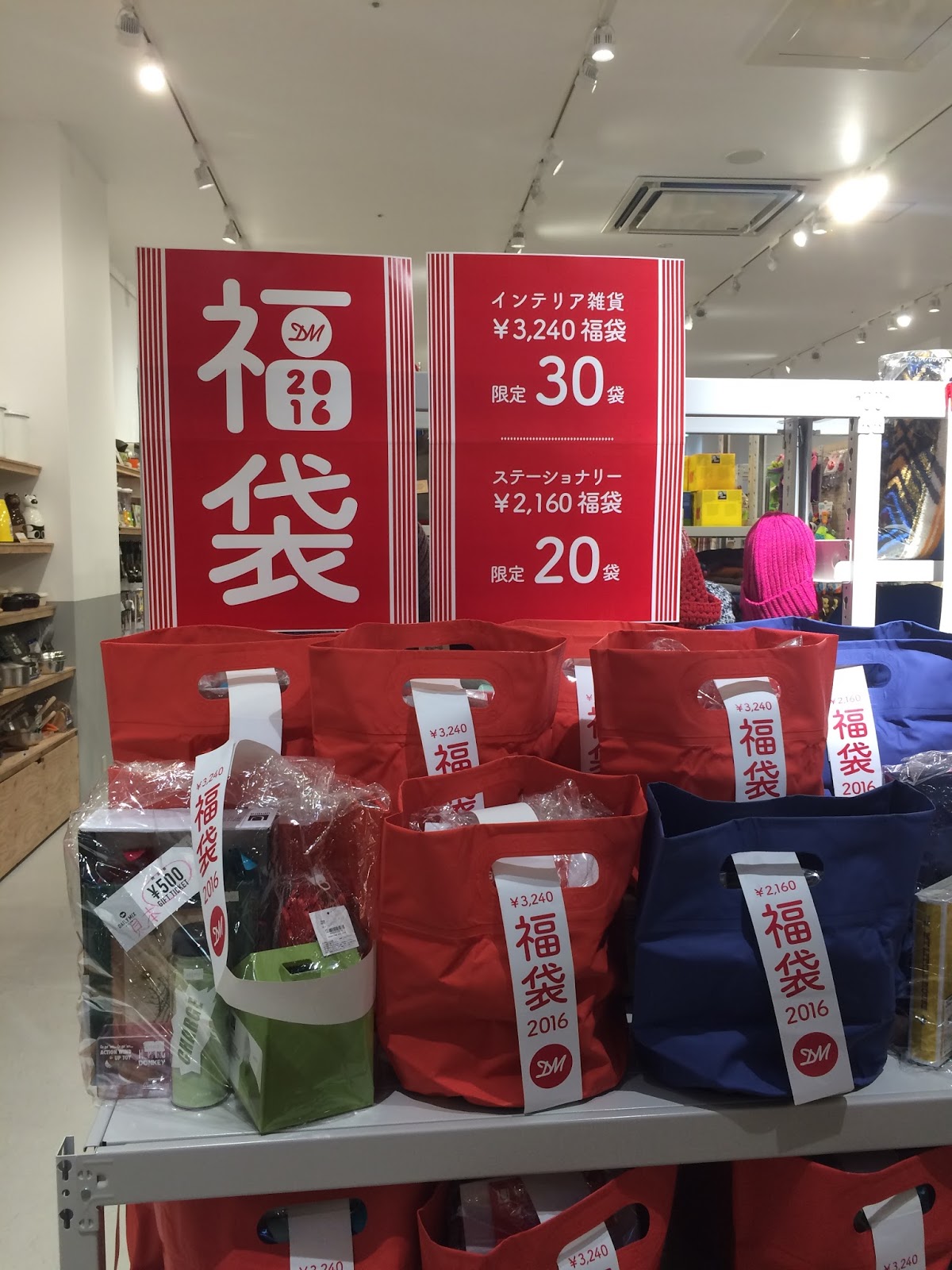

Some of the fukubukuro we saw at the mall today

We really lucked out this year with what we bought! It's exciting to have a mall nearby, and we found fukubukuro at many of our favorite shops. After purchasing a few lucky bags, we returned home to unwrap our surprises. We tallied up the total cost of what we spent versus the total worth of the items, and found that we only spent about 1/3 of the total worth! What a deal!

 
Fukubukuro goodies: great deals on some things we've been wanting for a while!

These are just a few of the many New Year's traditions we've encountered so far in Japan, though I know there are several others! We wish you a happy new year, regardless of where you are, and hope that you enjoy your annual customs and traditions!


Tuesday, December 24, 2013

christmas and kurisumasu

As we prepare for our third Christmas in Japan, we are remembering traditions that we grew up with and reflecting on some of the Japanese holiday customs as well. Doing this, I realized that I've never written a blog about how the Japanese celebrate this traditionally-western holiday! So here are some of the similarities and differences between Christmas in America and クリスマス in Japan.

The first thing we tell our American friends about Christmas in Japan is the KFC phenomenon. Years ago, KFC launched a campaign to sell fried chicken for Christmas dinner. Not only did this take off as a popular annual delight, but most of the Japanese we have become friends with believe that this is an American tradition. They were heartbroken to find that most Americans do not, in fact, get KFC for Christmas dinner. Starting in November throughout Japan, you can find Colonel Sanders decked out in Santa attire, and the lines for Christmas chicken can be hours long.

Colonel Santa draws customers into KFC for Christmas

One similarity between Christmas in America and in Japan is the music. American holiday music can be found in shopping malls starting in November. In most areas of Japan, there are city-wide speaker systems to alert the public in case of earthquakes, fires, and other emergencies. During the Christmas season, our town uses the speaker systems in the city center area to play holiday music in the evenings. There is nothing more beautiful than taking a stroll through downtown in the snow, looking at the lights and listening to Bing Crosby croon a classic Christmas tune.

On that note, Christmas decorations are also popular here in Japan. You won't find many houses decked out with lights or inflatable snowmen, but the town centers and shopping malls often have Christmas trees and lights all over. Our town center usually has a large Christmas display with a huge tree and beautiful lights. Bigger cities have Illuminations, entire streets covered with lights and music.

Ben at American Park at Christmas in Misawa

Musashino Illuminations in Tokyo

Roppongi Illuminations in Tokyo

Shinjuku Illuminations in Tokyo

Christmas Eve is the perfect evening to view a city or town's Illuminations or town center festivities. Christmas Eve is a time for families and couples. In fact, Christmas Eve is the real holiday in Japan - Christmas Day is usually spent at work just like a normal day. There is no mention of a manger or Jesus or church visiting. There are no cookies left out, visits from Santa, or presents to open. On Christmas Eve, though, you'll see couples (often hand-in-hand - it's one of the few times in Japan you will actually see some PDA. Usually it's kind of frowned upon...) and families spending time together and enjoying the lights, music, and companionship.


Couple holding hands at Shinjuku Illuminations in Tokyo

For a country that really doesn't celebrate Christmas, you can easily find Christmas decorations, lights, and Christmas themed food and drink just about anywhere. Bakeries will often have Santa or Christmas-themed pastries, which are always adorable!

The Japanese don't typically exchange gifts for Christmas, but often give gifts and letters/cards for the New Year. Gift exchanging is not done frequently in Japan, so when it is done, it's not something to be taken lightly. Where in America, we wrap gifts in a decorative paper bag or paper wrapping that is later discarded, gift wrapping in Japan is typically just as important as the gift itself. Often, gifts are wrapped furoshiki style, which is a large decorative piece of cloth. Wrapping a gift in Japan is like tying a scarf - everyone has their own personal and artistic way of doing it. The cloth can be used again for many different things.

Various gifts wrapped with summery furoshiki

All in all, we love being able to share our Christmas traditions with our Japanese friends and to learn how they like to celebrate as well. It's one of the many wonderful things about being able to travel and live in another country!

We want to wish all of you a Merry Christmas (or Merii Kurisumasu) and a happy new year!

Thursday, June 6, 2013

taiko

Today, our base Taiko team came to perform. Some of our students (including one in my class) have been practicing with them to learn a few songs to perform in front of the school. After this, the Taiko team performed some of their favorite challenging songs.

Taiko (太鼓) means "wide drum" in Japanese. The art of Taiko originated as a form of spiritual worship, and it is now used in festivals and even movies. It is very rare that Americans are able to perform with professional Taiko, because the traditional Taiko forbade foreigners from participating. The Dragon-Eagle Taiko Team, coached by Kazuko Igarashi, is Misawa’s Taiko team and is one of the few American teams to have ever performed with Japanese professional Taiko. 

Here is one of the songs they performed: