Monday, February 17, 2014

memories and maple syrup: a paleo barbecue sauce recipe

I've never been a fan of barbecue sauce. Living in Reno for so long, I always loved the summer activities. The Balloon Races, Hot August Nights, the Air Races...and the Rib Cook-off. With 500,000 visitors and dozens of barbecue-rs each year, I was bound to eventually find a sauce that tasted right to me.

Ribs + friends = a good day

I remember the year I finally found a sauce that I liked! After getting married and moving, my mom would get me a bottle nearly every summer to put in my Christmas stocking.


The only barbecue sauce I've ever liked!

After going gluten and corn free, most sauces were suddenly not safe for me to consume. Most of them contain soy sauce (which has wheat) or corn syrup or maltodextrin, which are all red flags in our household.

My hubby does enjoy a good barbecue sandwich occasionally, though, so finding a safe version was something I always knew I would eventually need to find. In doing so, I realized that I could make a version that I might actually enjoy too!

I've always liked my barbecue sauce more sweet than tangy, so I tried experimenting with maple syrup. You could probably use honey in lieu of the maple if you prefer a more honey mustard-y vibe. (I'll probably try it next time I make this.) Hope you enjoy, and let me know if you try it with a different combination!

Paleo pork sandwiches with the maple barbecue sauce!

Ingredients:
  • 1 cup ketchup (I use Organicville, which is gluten and corn free!)
  • 4 tablespoons organic apple cider vinegar
  • 1/2 cup 100% maple syrup
  • 1 tablespoon chopped onion or onion powder
  • 1 tablespoon coconut oil
  • 1 tablespoon ground mustard 
  • 2 garlic cloves
  • 1/2 teaspoon salt (or more, to taste)

Directions:
  1. Mix all ingredients in a saucepan and bring to a boil.
  2. Reduce to a simmer and cook uncovered for 20 minutes, stirring occasionally.
  3. Use immediately or refrigerate in a glass jar for later use.


Saturday, February 8, 2014

my fajitas! (a grain free tortilla recipe)

One of my favorite scenes from Friends - I always
think of it when I make fajitas! 


Last month, we decided to try and gradually cut grains out of our diet. While going gluten and corn free was 100% necessary for me, I tend to feel better when I also limit my grain intake.

We started with one grain-free day a week for a month, and now we are at two. We're working our way to the point where most of what we eat is grain free. (At this point, I don't see the need to go 100% Paleo, but we're in an experimentation phase so I suppose that could change.)

Since going gluten free I've been trying to find a tasty and (at least somewhat) easy recipe for tortillas. We used to live off of Mexican food, but it's nearly impossible to find decent wheat AND corn free tortillas. That means no enchiladas, no nachos, no burritos, no tacos... (Are you drooling  yet? Yeah, I kind of miss Mexican cuisine!)

The experiments have gone...well, so-so. The rice or sorghum based recipes we have tried tasted dry and felt as stiff as cardboard. After many trials, we were able to create something pliable and tasty, but it had more of a chalupa-esque consistency. It works well as a flat-bread, but not for tacos or enchiladas.

We have made cauliflower tortillas several times, and while they are delicious, they are labor-intensive and don't really work if you're short on time. They also haven't held up well for leftovers.

So I've been experimenting and putting together different recipes to find an easy and delicious tortilla. This recipe will work to make tortillas OR flat-breads - the only difference is how much batter you pour into the pan!

Today I was craving fajitas, so I doubled the recipe (for leftover purposes) and whipped these up! They held perfectly and tasted delicious. 

(For the pineapple chicken recipe to stuff inside your tortillas,
click here!)


*Note: It's been nearly two years since I have had a wheat tortilla. I think these grain free tortillas taste fabulous, especially compared to the other recipes I have tried. Ben still eats at Taco Bell occasionally and he says that these taste good and have the right consistency and pliability, but taste a bit different than regular tortillas. I played around with the recipe and he liked them better the second time. Just want to give you a disclaimer that you will probably notice a difference between these and regular tortillas!*


Grain-Free Tortillas - Recipe makes 4 tortillas or 3 flat-breads (using a 6-inch skillet)

Ingredients:

  • 1/2 cup almond flour (you can buy almond flour or use a coffee grinder and grind your own!)
  • 1/2 cup arrowroot starch
  • 2.5 tablespoons water
  • 4 egg whites
  • scant 1/8 teaspoon pepper
  • scant 1/4 teaspoon salt
  • coconut oil for the pan (I use a tiny bit of coconut oil for each tortilla because it adds a nice flavor. You can use whichever oil you prefer...)

Instructions:

Mix all of your ingredients (except the oil). I use a small six inch skillet - you will want to use something small, as your batter will be thin and will fill the space you pour it into. Heat your skillet on medium-low and place a dab of coconut oil. Once it melts pour 1/4 (about one small ladle-full) of batter into the skillet and make sure it spreads evenly. 

The tortillas are thin and will cook quickly, so don't leave them on the pan for too long! When first removed from heat, the tortillas will seem stiff (don't worry - after cooling for a few minutes they will be nice and pliable!)

Hope you enjoy! Leave a comment if you try them and let me know how they worked!

Friday, February 7, 2014

a little bit of hawaii: a paleo chicken recipe

I have a secret.

Okay, well it's not really a secret...but I LOVE pineapple.

I think it's the perfect chilled summer fruit on a hot day. It's great in the winter to remind me of summer. It's amazing in smoothies. On top of ice cream. On pizza. Basically, it's one of the most diverse fruits I know of and I love to cook with it.

I have another secret.

Until a year ago, I had never cut a pineapple.

I feel silly saying this now, but it was so easy to buy pre-cut pineapple or even canned chunks of the delicious fruit. With all of my food sensitivities now, I find that the more self-preparation I can do, the more secure I feel that I won't get sick.

Plus, pineapples aren't as difficult to chop up as I always thought they would be! My dream for next summer is to find a pineapple corer to make the process even easier (and to help keep down the amount of pineapple wasted by cutting it up with a knife.)

We picked up a pineapple a few weeks ago, so I decided to do a bit of experimenting. It was more of an "add a bit of this and a dash of that" situation, but it was delicious! It's similar to a Hawaiian-shoyu chicken casserole. I made it again today and wrote it all down so I could share it with you! You can alter any of the ingredient amounts to taste.


Ingredients:
  • 4 large boneless, skinless chicken breasts
  • 1 pineapple
  • 2-3 bell peppers (I like to get three different colors to make it more festive!)
  • The juice of 1 large orange (or approx. 1/3 cup of fresh orange juice)
  • 1/3 cup raw honey
  • 1/3 cup coconut aminos (or soy sauce if you're not worried about being Paleo)
  • 2 tablespoons organic tomato paste
  • 2 cloves of garlic, pressed (or two tsp. minced garlic)
  • 1 teaspoon salt 
  • 1/4 teaspoon pepper

Instructions:

Preheat the oven to 375. Cube the chicken and pineapple; put in a 9x13 inch casserole dish. Slice bell peppers and add them to the dish. 

In a separate bowl, mix all other ingredients. Spoon the mixture over the chicken, pineapple, and pepper mix. Stir well to coat chicken. Cover and bake for approximately 40 minutes.  (Note, our oven cooks a bit differently than others, so your timing may be slightly different.)


I've put this over rice (of course, that would negate the Paleo-ness of the recipe) and over cauliflower rice. Today, I used it as the stuffing for grain free fajitas (click here for the tortilla recipe) and it was delicious!

Tuesday, February 4, 2014

gonpachi and allons-y!

It's been dreary and wintry over the last few weeks, so I've been looking back at vacation pictures, wistfully dreaming of warmer (and snow-less) days. I realized today that I never blogged about our Tokyo Thanksgiving trip...so here we go!


Ben and I have some friends who also teach in Japan - we met them while living in California and we always see each other when we all go home to visit family and friends. Last summer, we agreed that the next time we saw each other needed to be in Japan. We decided to meet in near the middle, in Tokyo, for Thanksgiving.

As per the usual, we took the overnight bus and arrived in Tokyo around 6 am. Now that we are seasoned Tokyo veterans (three times brings us to expert status, right?) we had no problem traveling through Shinjuku Station with our luggage and making our way through the various metro lines to get to Nogizaka, the closest station to our hotel. It felt like decades ago that we had made our first trip to Tokyo, marveling at the sheer size of Shinjuku and the tens of thousands of people making their ways through the busiest train station in the world. This time, it was just the first station of many to go through on our first day.

Out of the 50 busiest train stations in the world, 44 of them
are in Japan, with Shinjuku being the busiest.


Once we made our way across the city and settled into our hotel, we visited Roppongi to see all the Christmas decorations. We had heard Roppongi was home to some amazing decorations and the famed Illuminations.


You might remember the spider from previous photos...


After taking in the sights, we headed to Arisugawa Park to meet our friends. We enjoyed a nice stroll through the park, photographing the autumn leaves and catching up. Then we made our way to Gonpachi, my favorite Izakaya restaurant. The food was amazing, as always, and we were happy to see that our friend Teresa still worked there.


The more times we visit this park, the more I think it's
become my favorite spot in Tokyo...


I'm always captivated by the architecture of this
building. It was especially beautiful with the sunlight
streaming in through the windows!


After our meal, we proceeded to Harajuku to visit Meiji-jingu, a Shinto shrine named after Emperor Meiji. It was quite lovely, though the wall of sake barrels was my favorite part of the experience. Well, that and the Allons-y shop we spotted on our way back to the train station! (Finding a Doctor Who reference in Japan is no easy task...but more on that later.)

Torii Gate entrance to the shrine complex

Kazaridaru, or decorational sake barrels, outside Meiji Shrine

Gateway to the courtyard

Meiji Shrine with the Docomo Building in the background

"There's an old Earth saying, Captain. A phrase of great power and wisdom and
consolation to the soul in times of need. Allons-y!" 


Exhausted, we all headed back to our hotels to try and get some shut-eye before our early morning trek to Disneyland!


Friday, January 31, 2014

let's get ready for some football!

My team is in the Super Bowl! This (mostly) never happens.

In fact, it's only ever happened once before. It's spectactular that both times will be incredibly memorable for me, for reasons other than (or let's face it, in addition to) the Seahawks playing.

Our first Seahawks Super Bowl was just after we had gotten married. Things were a bit stressful. Ben was working two jobs and I was student teaching and taking classes. Money was tight, and so was time. My lead teacher had a friend in management at one of the big Reno resort hotels who had given her two tickets to their huge annual Super Bowl party. She always had a big to-do at her house for the game so she gave the tickets to us.

It wasn't a big thing to her but it was to us. This was before Ben worked in the hotel industry and we got to attend events like this all the time. We were astounded at the free food and favors, the huge tv's, and all the team spirit of all the attenders.

We (the Seahawks) didn't win that day, but it was a day I'll never forget.

This year, we're in the game again.

It's been another stressful and tight-on-money year, with just a few stand-out great moments. Work has been stressful, with our third principal in the three years I've been here. Every new administration comes with a new set of standards and expectations, so changing those every year is exhausting. Plus, our accredidation visit is this year so we've been struggling to stay afloat with everything that has been loaded onto our (collective) plates this year.

After finding out my beloved Seahawks were going to the Super Bowl, I really wanted to call in sick. Since we're a day ahead, the game is showed on Monday morning. It's enough to basically close down the base. Most squadrons have the day off to watch the game, but the schools are still open. Under normal circumstances I would have used one of my personal days and stayed home to watch the game, but I've been so sick with these other food intolerances that I've used them all up.

Our principal agreed to let us watch the game at school though.

She said as long as we had educational activities linked to football going on, we could have the game on in the background.

I don't think the words were all the way out of her mouth before I was planning and crafting and creating! Football spelling games, word searches, stadium architecture, graphing the winning teams, mapping past locations, ticket design...there are so many places to go with this!

So here we are, a few days before the big game. I'm ready for a win, and I'm ready to remember this second Seahawks Super Bowl as a bright and exciting day amid some darker ones.


Friday, January 10, 2014

the path to recovery: 10 things about celiac I wish I knew before

I've had a surprising number of people tell me recently that they think they might have some level of gluten intolerance, and they have asked for advice on starting this journey to healing. I figured it was high time I posted some of the pointers and pitfalls I have learned while going through my own Celiac journey.

1. Get tested. There are a few different tests doctors can do to diagnose Celiac/gluten intolerance. One is a blood test, which is known to be somewhat inaccurate. Many people with gluten issues will get a negative on the blood test, but it's a start and it's easy to do.

The more complex way of getting tested is an endoscopy. Many doctors will suggest this, and many will say it's an unnecessary surgery if you don't know what's wrong. The problem is this: to get accurate results on an endoscopy, you have to eat gluten consistently for several weeks. If you go through an elimination diet, cut gluten, feel better, and decide to do an endoscopy to back up your results, you will have to start eating gluten again for six weeks and go through all the pain and suffering of reintroducing it into your now-healing body. My suggestion is to research the symptoms to see how many you have, and talk to your doctor to make the best decision for you. Everyone is different and, unfortunately, there is no one perfect way to go about it.

2. Cut out the gluten. Once you find out that you have Celiac or gluten intolerance, the key to remember is that NO gluten is ok.

None.

Not even a speck, (probably) for the rest of your life.

I will harp on this over and over again, because mainstream media and most of your friends will not understand this. They will tell you over and over again that because Celiac is not an allergy, a little bit won't hurt you. Of course, seeing celebrities tweet about their gluten intolerances while posting pictures of themselves eating cheeseburgers and pizza the next day doesn't help our plight.

What they don't understand is that Celiac an Auto-Immune disease that actually causes your body to attack ITSELF any time you ingest gluten. The amount of gluten that you can fit on the nail of your pinky finger can cause severe reactions and mucosal damage to your intestines.


Cutting out gluten can seem easy to an outsider: stop eating bread and crackers and you're good, right? Well, it's not quite as easy as that. Because everyone is different, you may find you react to even the slightest touch of gluten. A "gluten free" label on a box doesn't automatically mean a product is processed in a dedicated gluten-free factory. Cross contamination is a very serious threat to those of us who cannot tolerate gluten in any way, shape, or form. I have found the internet to be a necessary tool while grocery shopping. (I will admit our first few months of grocery trips were filled with anxiety and internet searches in the middle of each aisle.) Most websites will have a "gluten" entry in the FAQ section, telling you whether their factory has dedicated lines or factories for their products.

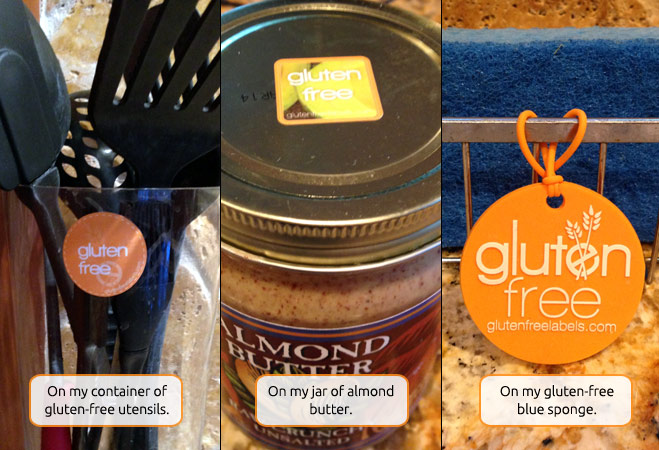
Cross contamination is to be expected in factories and restaurants, but it can also happen in your own home. I suggest replacing your pots and pans, your toaster, cooking utensils, Tupperware/storage containers, and any non-stick or plastic cooking appliances. Disinfect your microwave and fridge. It's easier for a Celiac to have a dedicated gluten free kitchen, though that is not always feasible for everyone. If you must have gluten in the house, store it in a separate area and disinfect all counters and appliances between cooking with gluten and preparing your food. Label your gluten free utensils and store them in a separate area. This was something I learned the hard way, and hope that you won't have to.

Photo courtesy of Gluten Dude
The most important thing to remember is that cheating will set back your healing. It might be easier to stop at a fast food joint than to think ahead and pack snacks, but your body will regret it in the end.

3. Beware of hidden gluten. Gluten is everywhere. I once was sick for almost a month because the eggs we bought were sprayed with an anti-cracking spray containing gluten. Do your research, because there are naturally gluten free products that could, in fact, contain gluten. Oats, for example, do not have a gluten protein, but are often processed in factories (or planted in fields) also containing wheat. Certified gluten free oats are a must for anyone with Celiac. Some fruits are sprayed with gluten-containing chemicals for preservative purposes.

Gluten can also be found in several non-food places. Glue, makeup, detergent, shampoo, lotion, and hairspray can have gluten in them. If you find that you are still getting sick despite cutting out gluten from your diet, you may want to check into your other products. Pet food is another place to watch - you feed your pet something with gluten, your pet licks itself (or things around your house), you touch it and then touch your face or mouth or food, and voila, sick central.

4. Find a blog or book or support group. They are all over the place. Finding a community (or author  or blogger or friend) who has Celiac can be a huge part of the healing process. Not only can others help you to troubleshoot issues, help you find recipes and brands that are safe, but they can help you to realize that


you

are

not

alone.

Some of my favorite bloggers are Gluten Dude and Celiac and the Beast. They both use humor and sarcasm to relate their Celiac stories and advice. They are my kind of people. If that's not your style, all you need to do is google "celiac bloggers" and hundreds of them will come up. Just make sure that whoever you follow has done the research and knows the facts. The last thing you want to do is to base any of your lifestyle changes on someone who doesn't know what they are talking about.

5.  Keep a food diary. You have probably done this in your journey to figure out what the heck was wrong with you, but I would recommend keeping it for a while. The reason for this is that down the road, you may find that you have developed other food allergies and intolerance. Around the time of my diagnosis, I found out I was lactose intolerant. About six months later, I had to do another elimination round to find out that I can't eat anything with corn or corn derivatives.

6. Don't rely too heavily on any one food while you heal. I wish I had known this when I was a baby Celiac. I had my mourning period and then started to find new recipes. We had corn tortillas available here, and it became Mexican night. A few nights a week. Tostadas, and tacos, and burritos galore. Until a few months later when I started feeling awful again. Relying too much on one food (in this case, corn) while your gut is healing can lead to an intolerance down the line.Vary what you eat and go easy on the grains while you heal.

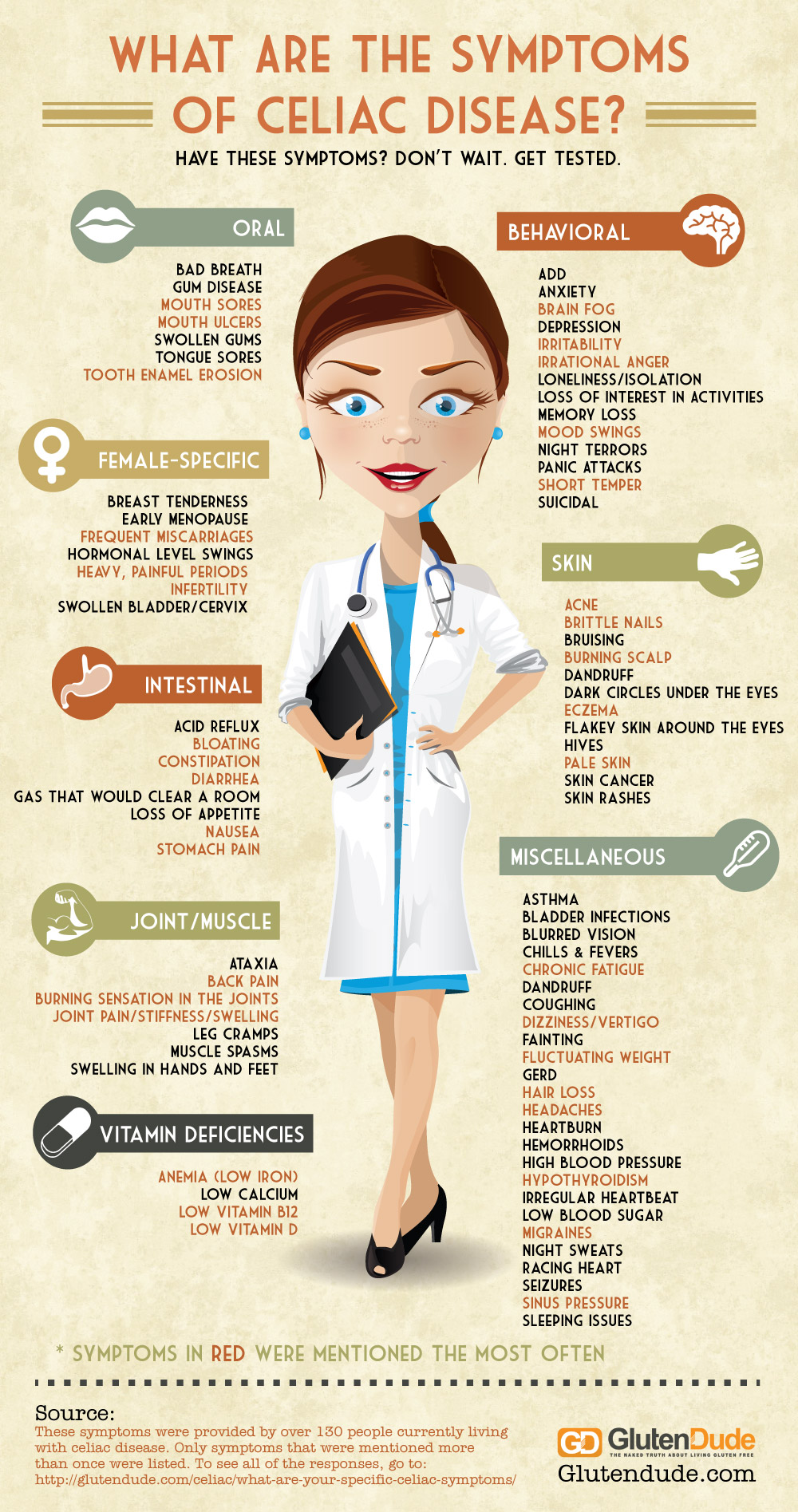
7. Learn your symptoms. If you are eating gluten continually now, you probably have some long-term discomfort. Once you make a commitment to go 100% gluten free, though, your symptoms will change. Your body is healing, and will react severely upon ingesting even a small amount of gluten because it's now a foreign substance. Knowing your own personal symptoms will help you to narrow down whether you ate something with gluten (and writing in your food diary will help you pinpoint what it was) or whether you're just feeling under the weather.

Unfortunately, everyone's Celiac is different. While there are some symptoms that most Celiacs have in common (like gastrointestinal issues like flatulence, diarrhea, reflux, bloating, and being severely over or underweight due to malabsorption), there are many that are a bit more rare, including neurological issues (like anxiety, memory loss, irritability, and migraines).

For instance, I nearly always have a panic attack, brain fog, intense sleepiness lasting for days and then insomnia lasting for weeks, and stomach pain when I have eaten something with gluten in it, in addition to several of the classic symptoms.

Infographic courtesy of Gluten Dude 
8. Know that some of the symptoms you feel now will go away, and others may not. Depending on what your symptoms are, how long you've gone undiagnosed, and your body type, you may feel better immediately or you may have long-term symptoms that will continue. These symptoms could be residual effects from the Celiac, or other disorders that are common in those with Celiac, like IBS, Hashimoto's, arthritis, or even Lupus.

In my case, the asthma and migraines cleared up almost immediately, and typically only bother me when I've been contaminated. Other symptoms, like the lack of energy, constant heartburn, and aching joints are issues that started with Celiac and haven't gone away for good.

There are things you will have to learn to live with, and there are a lot of nice natural remedies to help ease them a little bit. Peppermint oil, activated charcoal, and papaya supplements can help ease the pain after a "glutening." Also keep in mind that several of your long-term symptoms are caused by the malabsorption of your food and vitamin loss. I recommend talking to your doctor and checking to see if you have any vitamin deficiencies.

9. Eating out can be difficult...but not impossible. Apps like Find Me Gluten Free are a lifesaver to me when we travel in the U.S. I always go through the app and read reviews and then call the restaurant, speaking to a manager. Since I have several food intolerances, I explain ahead of time the accommodations I will need. Sometimes the manager will tell me it's not possible, and that's okay. I'd much rather learn that in a phone conversation than an hour after I've eaten. If the manager sounds confident and is able to explain the restaurant's policy on cross-contamination, we will make a reservation for a day and time that manager will be there at the restaurant.


When we arrive, I ask the host or hostess to talk to that manager. I introduce myself and they will usually seat us, introduce us to the servers, and go through their policies again to ensure the server is aware of how serious the condition is. Many restaurants are used to people coming in and asking for gluten free items, but very few of them are asking from the standpoint of avoiding illness, so it's important to make the distinction.

It does become tiring to do this EVERY TIME you go out and eat, but it's worth it to stay healthy. Eventually, the people around you will realize that you wouldn't go to all this length for a fad diet and they may even start to advocate for you. Several times this summer, friends and family members were the ones to ask the servers about their gluten free menus or kitchen policies so that I didn't have to.

10. On the note of friends... You will probably have friends, relative, co-workers, acquaintances, or even strangers give you their opinions on your "gluten issues." Some will be loyal and do everything they can to learn about Celiac and how to help you, and some will be fiercely opposed to anything being wrong with you.

You may have a mourning period as you realize that your whole life will revolve around your diagnosis for a while, until it becomes second nature.

As you realize that social engagements will never be the same, and traveling becomes stressful instead of relaxing and adventurous. 

As you come to terms with some of the symptoms that may never go away all because of a silly protein in some too-common grains. 

As you start to find some stability and revel in your new-found baking prowess, only to realize that your newest batch of muffins or bread loaves are crumbly and tasteless.

It gets tiring having to argue with people that Celiac is a disease and not a fad, but don't let it get you down. You will find out quickly who your true friends and supporters are - and they will help you get you through this. Surround yourself with people who are positive and encouraging, because you will probably have enough emotional roller coasters all on your own as you go through this lifestyle change. (This is also a good reason to get involved with a support group or community or even blog - the Celiac community is a very outspoken and supportive one.)

And then you'll get to that point where you realize you haven't been contaminated in months, instead of days. You'll impress your friends with your "icky gluten free food" that was so delicious, they didn't realize it was gluten free until you told them. You'll stop craving gluten-y food all the time, because you'll finally feel like yourself again. You won't feel the need to check every single product over and over again to double check that there isn't any gluten in the ingredients (though it's good to check occasionally since companies change their practices all the time.) You will come to terms with your disease and realize that it's only a small part of you, that you've overcome it and taken back your life.

You will know that not only can you survive this, but you can thrive.


I know this was a long post, but in all honesty, it sums up what I've learned over the past year and a half. It's what I wish I had found when I was first diagnosed, and I hope that it's able to help even one person as they start the road to healing. If you have any questions, please feel free to leave a comment or hit me up on facebook!

Tuesday, December 24, 2013

christmas and kurisumasu

As we prepare for our third Christmas in Japan, we are remembering traditions that we grew up with and reflecting on some of the Japanese holiday customs as well. Doing this, I realized that I've never written a blog about how the Japanese celebrate this traditionally-western holiday! So here are some of the similarities and differences between Christmas in America and クリスマス in Japan.

The first thing we tell our American friends about Christmas in Japan is the KFC phenomenon. Years ago, KFC launched a campaign to sell fried chicken for Christmas dinner. Not only did this take off as a popular annual delight, but most of the Japanese we have become friends with believe that this is an American tradition. They were heartbroken to find that most Americans do not, in fact, get KFC for Christmas dinner. Starting in November throughout Japan, you can find Colonel Sanders decked out in Santa attire, and the lines for Christmas chicken can be hours long.

Colonel Santa draws customers into KFC for Christmas

One similarity between Christmas in America and in Japan is the music. American holiday music can be found in shopping malls starting in November. In most areas of Japan, there are city-wide speaker systems to alert the public in case of earthquakes, fires, and other emergencies. During the Christmas season, our town uses the speaker systems in the city center area to play holiday music in the evenings. There is nothing more beautiful than taking a stroll through downtown in the snow, looking at the lights and listening to Bing Crosby croon a classic Christmas tune.

On that note, Christmas decorations are also popular here in Japan. You won't find many houses decked out with lights or inflatable snowmen, but the town centers and shopping malls often have Christmas trees and lights all over. Our town center usually has a large Christmas display with a huge tree and beautiful lights. Bigger cities have Illuminations, entire streets covered with lights and music.

Ben at American Park at Christmas in Misawa

Musashino Illuminations in Tokyo

Roppongi Illuminations in Tokyo

Shinjuku Illuminations in Tokyo

Christmas Eve is the perfect evening to view a city or town's Illuminations or town center festivities. Christmas Eve is a time for families and couples. In fact, Christmas Eve is the real holiday in Japan - Christmas Day is usually spent at work just like a normal day. There is no mention of a manger or Jesus or church visiting. There are no cookies left out, visits from Santa, or presents to open. On Christmas Eve, though, you'll see couples (often hand-in-hand - it's one of the few times in Japan you will actually see some PDA. Usually it's kind of frowned upon...) and families spending time together and enjoying the lights, music, and companionship.


Couple holding hands at Shinjuku Illuminations in Tokyo

For a country that really doesn't celebrate Christmas, you can easily find Christmas decorations, lights, and Christmas themed food and drink just about anywhere. Bakeries will often have Santa or Christmas-themed pastries, which are always adorable!

The Japanese don't typically exchange gifts for Christmas, but often give gifts and letters/cards for the New Year. Gift exchanging is not done frequently in Japan, so when it is done, it's not something to be taken lightly. Where in America, we wrap gifts in a decorative paper bag or paper wrapping that is later discarded, gift wrapping in Japan is typically just as important as the gift itself. Often, gifts are wrapped furoshiki style, which is a large decorative piece of cloth. Wrapping a gift in Japan is like tying a scarf - everyone has their own personal and artistic way of doing it. The cloth can be used again for many different things.

Various gifts wrapped with summery furoshiki

All in all, we love being able to share our Christmas traditions with our Japanese friends and to learn how they like to celebrate as well. It's one of the many wonderful things about being able to travel and live in another country!

We want to wish all of you a Merry Christmas (or Merii Kurisumasu) and a happy new year!

Friday, September 20, 2013

pumpkin spice and everything nice: an ice cream recipe

It's almost my favorite time of year: autumn!

The recent typhoons have brought cooler weather and our thoughts are on what comes next: leaves falling, sweater weather, and pumpkin spice everything!

I've been experimenting with ice cream flavors and decided to try out a pumpkin spice. It's like autumn in a bowl!

Ingredients:

-1 can full fat coconut milk (I prefer Native Forest - it makes the creamiest ice cream out of all the kinds I've tried.)

-2 T. raw cacao powder

-1/4 cup agave nectar, coconut nectar, 100% maple syrup, or even pure honey (I only use 1 tablespoon, but I don't like my ice cream very sweet)

-2 T. pumpkin spice blend**

Whisk until blended and then pour into an ice cream maker. **If you don't have one you can put in the freezer for six hours, stirring every hour.**

If you are looking for some crunch, I sometimes add a few Enjoy Life crunchy cookies after pouring the mix into the ice cream maker. Crumble 'em up and toss 'em on in!

**Pumpkin Spice: I make my pumpkin spice blend in bulk but you can put less of each in the batch if you don't use it often:

-1/3 cup ground cinnamon

-1 tablespoon ground nutmeg

-1 tablespoon ground ginger

-1-1/2 teaspoons ground cloves

-1-1/2 teaspoons ground allspice